
Upson County Court Records After Arrest
Court records after a jail arrest in Upson County follow a local chain: arrest, jail booking, first appearance, prosecutor charging decision, and clerk case record. The Upson County Jail Population Website shows the booking side of that chain. It can list the arresting agency, warrant number, statute, charge text, court label, and bond status. Those fields are useful starting points, but they are not the same as the formal criminal case file kept by the court.
The Upson County Sheriff's Office operates the jail under Sheriff Dan Kilgore, while formal court records after arrest move through the Upson County courts and the Griffin Judicial Circuit District Attorney's Office. For custody, roster details, and booking data, use Upson County jail inmate records. For booking photos tied to roster entries, use Upson County jail roster mugshots. For filed charges, dockets, dispositions, and court papers, the clerk and court channels matter more than the jail roster.
The court pathway also matters because the charge can shift. A person may be booked on an arrest warrant or officer charge, then later face an accusation, information, or indictment that is worded differently. Some charges are amended. Some are reduced. Some are dismissed or not pursued. The court record is the place to confirm what was filed and what happened next.
Find Upson County Court Records
The Upson County Clerk of Superior Court is the main local office for superior-court criminal dockets and filed case records. The clerk's public page lists a Criminal / Civil Search Website, e-filing for criminal cases, docket and record duties, and the office's public hours. Research found that the separate portal could be browser or redirect dependent, so the clerk page, phone, mail, and counter service are the reliable fallbacks when the online search does not load.
- Start with the jail roster and write down the exact name, arrest date, warrant number, statute, charge description, court label, and bond status.
- Open the clerk's criminal and civil search link from the official clerk page. If the portal fails, call or visit the clerk instead of relying on an unofficial index.
- Search by defendant name or case number when available. If only roster data is known, provide the arrest date and charge text at the counter.
- Read each filed charge, status, disposition, and docket event separately from the booking charge.
For older files or copies, contact the clerk at the Upson County Justice Center, 1185 Hwy 19 South, Thomaston, GA 30286. Clerk Teresa Meier's office is open Monday through Friday, 8:00 A.M. to 5:00 P.M., and the phone listed in the research is 706-538-2343. The mailing address is P.O. Box 469, Thomaston, GA 30286. Court records after a Upson County arrest are not confirmed by the jail alone.
| Search Path | Use It For | Local Notes |
|---|---|---|
| Criminal / Civil Search Website | Online court case lookup | Linked from the clerk page, but fetch failed during research, so browser access may vary. |
| Defendant name | Finding cases without a case number | Name spelling should match the roster or court filing as closely as possible. |
| Case number | Direct case retrieval | Best when a docket or court notice has already been issued. |
| In-person clerk search | Portal fallback and copy requests | Bring name, charge, arrest date, warrant number, or known court label. |
The official clerk page is the source for the court-search link and office information.
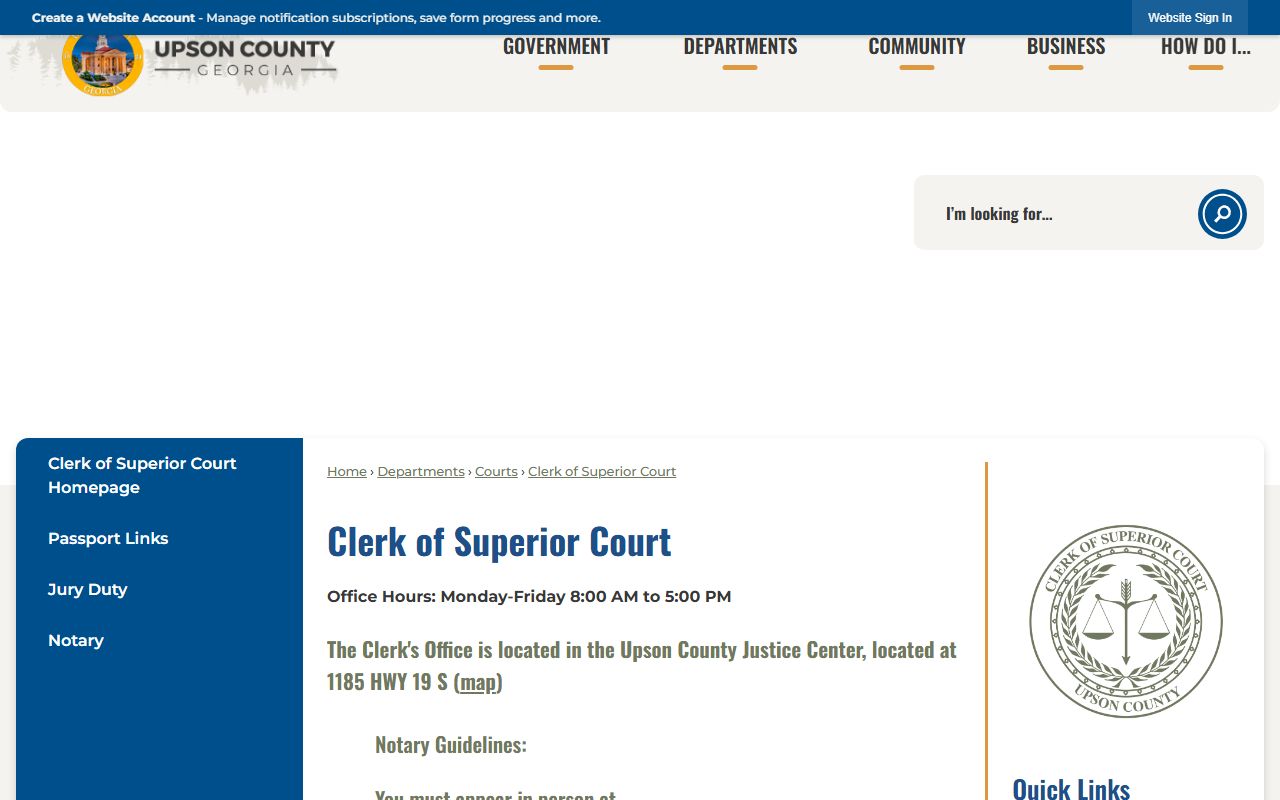
The screenshot confirms that the Upson County Clerk of Superior Court page is the starting point for criminal and civil court search access, with phone and in-person fallback when a portal search is not enough.
Upson County Arrest Court Timing
The Upson County Magistrate Court scheduling page describes the first-appearance stage after arrest. First appearances are scheduled on Mondays, Wednesdays, and Fridays at 2:00 P.M., with an on-call Sunday judge as required. The same county page states that warrant and first-appearance hearings are to be scheduled within 48 hours after arrest, or within 72 hours if the arrest happens on an active warrant.
That timing does not mean the full court record is finished in two or three days. It means the initial hearing and bond review should occur within that local schedule. The prosecutor still may review evidence, decide what charges to file, change the charge wording, or send a felony matter forward. Court records after arrest can therefore lag behind the jail roster, especially when the roster already shows a warrant number or a court label but the clerk case has not yet appeared online.
The Magistrate Court page documents Upson County's first-appearance timing and warrant-hearing schedule.
The schedule helps explain why a person may appear on the jail roster before a full court case record is easy to find.
Upson County Arrest Charging Documents
After arrest and booking, the charge record becomes more formal when a charging document is filed. Upson County felony prosecutions are handled through the Griffin Judicial Circuit District Attorney's Office, which serves Fayette, Spalding, Pike, and Upson counties. The Upson County DA page describes felony prosecution in Superior Court and lists examples such as aggravated assault, armed robbery, burglary, major drug violations, murder, rape, and higher-value theft. Because the official local page may be stale on the current officeholder, the office name is safer than naming a current district attorney.
| Document | Who Uses It | What It Means After Arrest |
|---|---|---|
| Complaint | Law enforcement, prosecutor, or lower-court process | Often tied to the initial allegation, warrant, or lower-court filing that starts the case path. |
| Information or Accusation | Prosecutor | A prosecutor-filed charge document that may replace or refine the booking charge. |
| Indictment | Grand jury | A formal felony charging document used when the grand jury returns charges for Superior Court. |
The Upson County District Attorney page gives the local DA phone as 706-647-4042 and the local mailing address as P.O. Box 871, Thomaston, GA 30286. Use the DA office for prosecution-stage questions, not for basic jail custody confirmation. The jail can confirm custody and roster facts, but the prosecutor decides what charges to pursue in court.
Upson County Court Charge Status
Charge status terms show where the court record stands. They also show why court records after a jail arrest must be read with care. The jail roster may show a charge description, a statute, a warrant number, and a court label. The court record may later show a different charge level, a reduced count, a dismissal, or a final disposition. A disposition is the result of a charge, such as a plea, verdict, dismissal, or other court action.
| Status | Meaning in a Upson County Court Record |
|---|---|
| Pending | The charge has been filed or remains open, and no final disposition is shown. |
| Amended | The charge wording, count, statute, or level has been changed by the prosecutor or court. |
| Reduced | The charge has been lowered to a lesser offense or lower charge level. |
| Dismissed | The charge ended without a conviction on that count. |
| Nolle prosequi or nol pros | The prosecutor declined to proceed with that charge. |
| Bound over | A lower-court matter was sent forward to Superior Court, often in a felony path. |
| Conviction | A guilty plea, verdict, or other adjudication of guilt was entered. |
Note: A roster charge is a lead for research, not proof that the person was convicted of that offense.
Bond Records After Arrest
Bond status is one of the clearest links between the jail roster and the early court process. The Upson County roster has shown Total Bond values such as numeric amounts, NOT SET, and DENIED. Research also found Upson court calendars with bond amount, bond date, bondsman, and jail-location fields. A bond is a court-authorized release condition. A hold or detainer is different. It can keep a person in custody for another agency, probation matter, failure to appear, or separate case.
| Bond Type or Status | How It Works in Upson County Records |
|---|---|
| Cash bond | Money is paid to meet a court release condition. Confirm accepted methods and hours with the jail. |
| Surety bond | A licensed bonding company posts surety. Court calendars may show a bondsman field when recorded. |
| Own recognizance | Release by court order based on a promise to appear, sometimes shown as OR bond. |
| Not set | Bond has not been set or is not shown in the public roster yet. |
| Denied or no-bond hold | The listed matter does not allow ordinary bond release at that point. |
| Hold or detainer | Another agency or case may block release even when one charge has a bond amount. |
For current bond posting instructions, call the Upson County Jail at 706-647-7411. For formal bond orders, conditions, and later case events, check the clerk record or contact the court that issued the order.
Upson County Warrant Records
The Upson County Magistrate guidelines state that magistrate judges issue many warrants for the City of Thomaston and Upson County. For a criminal arrest warrant, an officer presents an affidavit to Magistrate Court, swears to probable cause, and the judge decides whether to issue the warrant. The jail roster then may show a Warrant# after the person is booked, but that is not the same as a public active-warrant search.
No official Upson County active-warrant lookup was found in the research. The practical chain is narrower. Use the roster only after booking. Use Magistrate Court for warrant procedure and first appearance. Use the Sheriff's Office at 235 Aviation Drive for custody and records-request routing. Use the clerk for court cases, failure-to-appear matters, and filed records after the warrant leads to a case. Active investigations, sealed warrants, and juvenile matters may not be publicly released.
Charge vs Conviction Records
An arrest charge is an allegation. A conviction is a court result. The difference is central to Upson County court records after arrest because the roster may show a charge long before the court reaches a final result. Georgia public-record access may allow the public to see many open case records, but an open charge should not be described as a conviction unless the court record says so.
| Point of Comparison | Charge | Conviction |
|---|---|---|
| Stage | Allegation after arrest, warrant, accusation, information, or indictment. | Final or adjudicated result after plea, verdict, or other court action. |
| Proof level | Often begins with probable cause or prosecutor filing decision. | Requires a guilty plea, verdict, or qualifying adjudication. |
| Record source | Roster, warrant row, complaint, accusation, indictment, or docket. | Disposition entry, sentencing record, or final court order. |
| How to cite it | Say the person was charged or booked on the charge. | Say convicted only when the court record shows a conviction. |
Sealed and Restricted Court Records
Georgia often uses the term record restriction for limiting public access to certain criminal history information. People may also use sealed or expunged in a broad way, but those words should not be treated as the same thing. The exact path depends on the record type, the court order, the agency that holds the record, and the disposition. A dismissed charge may still need proper restriction paperwork before it stops appearing in public channels.
| Term | Public Access Effect | Upson County Records Route |
|---|---|---|
| Sealed or restricted | Public access is limited, but some court or law-enforcement access may remain. | Start with the court order or agency record that authorized restriction. |
| Expunged | Often used to mean erased, but Georgia record handling may be more specific than that word suggests. | Confirm the correct Georgia process with the court, attorney, or record-holding agency. |
| Dismissed | The charge ended without conviction, but public visibility may not change by itself. | Check the clerk case disposition and ask about eligible restriction steps. |
For court files, contact the Upson County Clerk of Superior Court. For sheriff booking records or jail records, contact the Upson County Sheriff's Office. For statewide criminal history, use the state process instead of assuming the local jail roster controls all public access.
Upson County Background Limits
Casual court lookup is not the same as a regulated background check. The Georgia Attorney General open-government FAQ explains public-record response timing and costs under state law, but consumer background checks have separate federal rules. A person, landlord, lender, employer, insurer, or screening company should not use jail or court lookup pages as a substitute for FCRA-compliant screening.
Important: Upson County court, jail, and roster data should be verified with the originating office before any serious decision.
Restricted Upson County Arrest Records
Some records after arrest are not open in the same way as ordinary docket entries. Juvenile matters, sealed files, restricted criminal-history records, medical or mental-health information, victim data, and active investigative material may be withheld or redacted. The Georgia Open Records Act favors public access to public records, but it does not make every field in a jail or court file public.
When a record cannot be found, use a source-by-source check. Confirm custody through the jail roster or jail phone line. Confirm filed charges through the clerk. Confirm prosecution questions through the Griffin Judicial Circuit District Attorney's Office. Confirm state-prison custody through the Georgia Department of Corrections only after transfer or sentence. That route keeps Upson County court records after arrest separate from booking records, mugshot questions, and statewide criminal-history searches.